
According to the American Cancer Society, colorectal cancer survival depends heavily on how early the disease is detected.
When found early—before it spreads beyond the colon—the 5-year survival rate is about 90%.
When discovered after it spreads to distant organs, the 5-year survival rate drops to about 14%.
That dramatic difference highlights one of the most important truths about colorectal cancer:
Early detection saves lives.
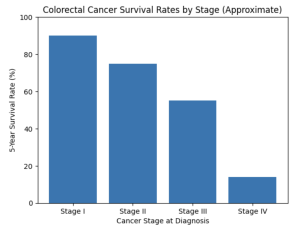
Survival Rates by Stage
Data from the American Cancer Society shows how survival changes as colorectal cancer progresses:
| Stage | Approximate 5-Year Survival Rate |
| Stage I | ~90% |
| Stage II | ~70–85% |
| Stage III | ~40–70% |
| Stage IV | ~10–15% |
These numbers demonstrate why screening and early detection are so critical. The earlier cancer is found, the more treatment options are available and the better the outcomes tend to be.
Why Early Detection Makes Such a Difference
Colorectal cancer often develops slowly over 10–15 years. The
It usually begins as small growths called polyps that form in the lining of the colon.
Screening tests can detect these polyps before they turn into cancer.
In many cases, doctors can remove the polyps during a colonoscopy, preventing cancer from developing altogether.
This makes colorectal cancer unique among many cancers because screening can actually prevent the disease, not just detect it.
The Role of Colonoscopy
Among screening methods, colonoscopy remains the most comprehensive test.
A colonoscopy allows doctors to:
- Directly view the entire colon
- Detect abnormal growths
- Remove polyps during the same procedure
- Identify potential problems before symptoms appear
Because of this ability to detect and treat issues early, colonoscopy plays a major role in improving survival rates.
Who Should Be Screened?
Most medical organizations recommend that adults at average risk begin screening at age 45.
Earlier screening may be recommended for people who have:
- A family history of colorectal cancer
- Certain inherited genetic conditions
- Inflammatory bowel diseases such as Crohn’s disease or ulcerative colitis
A healthcare provider can help determine the most appropriate screening plan.
A Message Worth Sharing
Colorectal cancer remains one of the most preventable and treatable cancers when detected early.
But awareness and screening are key.
Sharing these statistics with friends, family members, and loved ones can help encourage conversations about screening and prevention.
Knowing the numbers is enough to prompt someone to take action.
/ And that action could save a life. Don’t forget, when found early—before it spreads beyond the colon—the 5-year survival rate is about 90%.